How This Advisors Content Strategy Made His SEO Take Off
One advisor with a niche, and one full year of posting. Here's what Dan Leonard's SEO looked like—the slow start, the turning point, & the payoff.

Website Visitors From ChatGPT

Content marketing is a must for financial advisors.
You know you should do something, but it's tough to know where to start and rather difficult to keep up with once you do.
Blog posts, LinkedIn articles, social content—it all makes sense (in theory).
But what really happens between month one and month twelve?
Silence, a slow crawl, and probably an exhausted sigh, wondering whether any of it’s working.
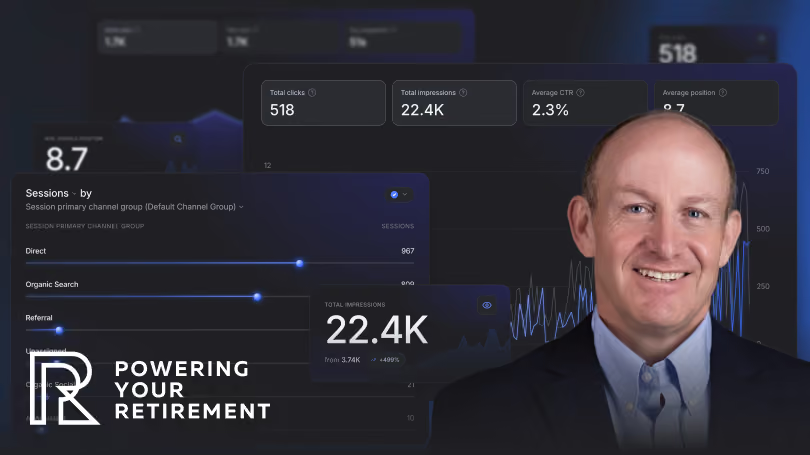
Daniel W. Leonard—Dan, as we call him—from Powering Your Retirement had lived this first hand.
The thing is, he stuck it out, and now his site is proof the strategy works.
Here's how we helped him get all the way there!
Dan Already Had The Niche
Dan had already defined his niche before we built his website. He knew he was going to work with PG&E employees.
See, utility workers have specific retirement benefits, pensions, and financial questions that are different from the average person's financial situation.
Dan understood their world and wanted to serve them as their trusted advisor.
When we looked at the keyword data prior to building his site, we saw there was solid search volume around PG&E retirement topics and not a lot of advisors competing for it
So, when it came time to build out his content strategy, we had a clear lane to work in from day one.
What The Content Strategy Looked Like
Every week, we’d optimize one blog for the keywords needed to rank and the phrasing needed to pass AI detection. Then, we’d write one LinkedIn article, and one social post.
Once every month, we’d throw the blog content into a value-packed email newsletter to fire off to his audience—an audience he’d built through lead magnets and events on the side.
That's the strategy we stuck to.
The goal in it all was to build a massive library of content: enough that Google could crawl, index, and start treating Dan's site as a subject of authority on each topic.
The Brutally Slow First Few Months
The first couple of months tend to be the ones where advisors give up.
In all reality, the numbers are often quiet, there’s maybe a handful of clicks here and there, and the impressions barely move at all.
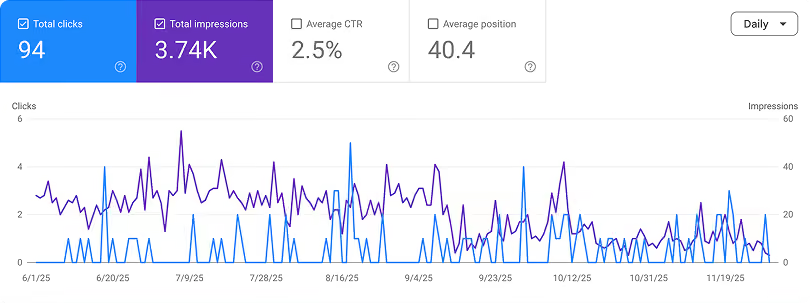
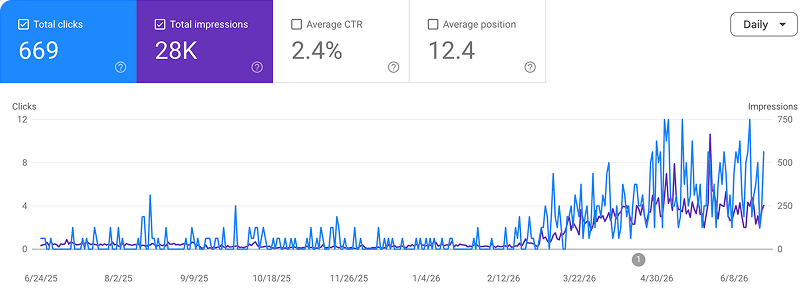
Dan's Google Search Console graph from July through December of 2025 is a pretty flat line with the occasional spike… not exactly the stuff that’ll get you all fired up.
Google won't hand out better rankings after three or four blog posts, but it will reward the websites that stay consistent and keep posting.
Dan's content library was growing, and his authority was quietly building. It just wasn't showing up in the data yet.
We both shared an understanding that we were in it for the long haul, which ultimately kept the pace and strategy going.
When Everything Started Moving
Around the start of 2026, the graph started changing.
Impressions—how many times Dan's site showed up in a Google search result—started climbing. The site clicks followed. As did his position on SERP’s.
His average position, which had been sitting well outside the top 10, started climbing. By the spring of 2026, his daily impressions started hitting the 200-400 range—and, better yet, his site clicks were spiking up to an average of 8 clicks a day.
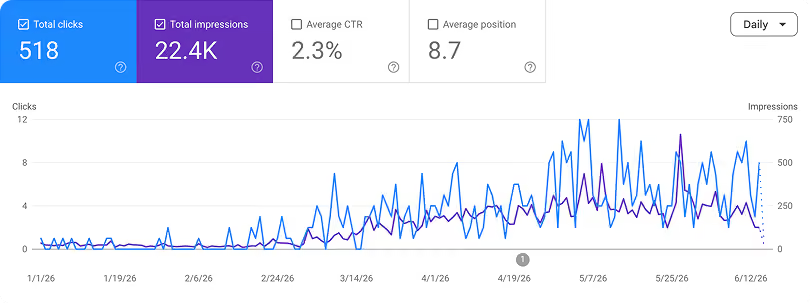
Over the full year (July 2025 to June 2026), the site pulled 592 total clicks and 25,600 impressions, with the largest haul of those coming from just the last 4 months.
We started noticing the same results on Google Analytics, with 3,994 new users over the year (up ~943% from the year prior).
Marketing Dialed In. Now What to Hone in on?
As Dan's library of content grew, we started seeing trends of which topics were performing better than others. The blogs about PG&E pensions and benefits performed especially well.
So, we started honing in on those and answering the exact questions that people are typing into Google when they're six months away from retirement, trying to figure out what they're entitled to.
We created more blogs around the topic, targeted better keywords, and went into more depth in the specific retirement landscape for PG&E employees.
Our content strategy continued to evolve. We saw what was working and kept doing just that.
Throwing AEO+GEO Into The Mix
AI platforms like ChatGPT and Claude are taking search by storm.
Used more and more everyday, they’re becoming the first stop for financial questions.
Let’s not be confused, they’re not the number one stop yet, Google still takes the cake.
But people are asking the LLM’s, and their chosen AI supplies answers.
If your content is well structured and authoritative enough, you’ll start showing up in the answers.
See, Answer Engine Optimization (AEO) and Generative Engine Optimization (GEO) generally follow the same principles as SEO, with a few varying tactics to show up in generative search.
While they move about as slowly as SEO, Dan's site has already seen a whopping 136 visitors come directly from ChatGPT over the past year, again, with the majority in just the last 6 months.
Just to make sure you’re getting what I’m saying here, that’s 136 PG&E employees asking about a financial advisor or related topic and navigating to Dan’s site as a product.
That number is going to keep growing as more people shift toward asking AI instead of Googling.
The content building into his SEO is the same content laying the groundwork for AEO+GEO.
What The Analytics and Data Prove
So, what does all of this mean for you? Two things.
First, niching works. Dan isn't trying to rank for "retirement planning" or “financial advisors”—keywords dominated by massive institutions with marketing budgets that dwarf smaller advisory practices. He's ranking for the terms his exact ideal client is searching.
If you’re wondering how to find these “niche” keywords, use the term “long-tailed keyword” in your search. We’ve put out blogs unpacking our whole strategy. Here’s one of those!
Second, consistency is the whole game. None of our posts went viral, and no single piece of our content flipped a switch. This was simply just a year of consistent blogging, posting, and publishing while the algorithm silently took notice.
Our results didn't arrive after three or four blogs. They arrived because month one happened, then two, then three, and eventually month eight swung by… and so on and so forth until we finally saw traction burst through the door.
What This Could Mean For You
Dan’s direct searches are up, organic searches are climbing, and AI-referred traffic has started showing up for the first time. All of those numbers are only going to continue building for him.
If you've been sitting on the idea of starting a content strategy, just know that it takes time.
The first few months are quiet, but you’ve got to stick to it anyway.
Over a year of consistent, niche-focused content, his site went from a quiet corner of the internet to one that's generating nearly 4,000 new visitors a year—and the curve isn’t slowing down. It’s actually still climbing today.
That's what our Advisor Content Package is designed to do.
We handle the blog optimization, the social posts and graphics—week in, week out. You show up as the expert. We make sure Google, ChatGPT, Claude, and the other LLMs start to agree.
If you want to see what that could look like for your practice, let's have a pressure-free chat!
More Success Stories
A mix of projects across branding, content, websites, and strategy.