

Dying Sites: The AEO Plummet From AI-Generated Content

Imagine you could set up an account, hand over a bit of info (and a few of your preferences), and have a site fully built for you.
Better yet, you’d have blogs, events, videos, and more posted on an ongoing basis without you ever having to touch them. Every piece would be optimized to show up in Google and in AI answers, generating leads without you lifting a finger.
It sounds like a dream to financial advisors. Heck, it even sounds like a dream to me.
That’s the pitch a growing number of platforms in the advisor space are making right now, AI-written content published on autopilot that promises to grow your traffic and fill your calendar. Let me walk you through the rest, using Google’s own guidance, data from the biggest names in SEO, AEO, and GEO, and what we’ve learned firsthand writing content for advisors since AI showed up.
Stick around toward the end of this blog, too, where I literally tell you how to build your own “living” site with Claude (though other AI tools do the same).
If It Worked, Everyone Would Be Doing It
Start pulling at the dream a little and the questions along the right line of thought come fast. If it can be done, why wouldn’t everyone do it? If everyone could do it, wouldn’t that make it all the harder to rank? If it’s harder to rank, wouldn’t Google and other search engines make it more and more difficult to just beat the system?
Then there’s the business side of it. If a firm had cracked the code on AI content that ranks, why would they sell it to financial advisors? Think about how much more money they’d make selling it to the major publications of the world, the ones paying hundreds, if not thousands, of writers’ salaries. Even if the AI content came out a little worse, offloading a chunk of those salaries would be worth a fortune.
Yet the major publications still have people writing their content, and they’re still far outperforming everyone in search.
The SEO companies themselves are no different, and they have every tool and dataset you could ask for. Ana Camarena, who heads organic content strategy at Semrush, says AI helps their blog produce content but “only gets us part of the way.” The SEO teams Semrush surveyed in the same study tell a similar story:
- 87% of SEO teams say their content is either fully created by humans or heavily led by humans.
- 64% use a human-led, AI-assisted workflow, making it the most common way content gets made today.
- 23% create their content entirely without AI.
- 70% say speed is the top benefit of using AI, but only 19% say it improves content quality.
If the people building the SEO tools, and the teams using them every day, still keep humans in charge of their content, that should tell you something.
Google Has Caught Every Shortcut So Far
Advisors generally haven’t heard of keyword stuffing. Just a few years ago, people would cram a tonne of keywords onto the end of landing pages and articles, trying to skip the work of writing good content and still get Google to index and rank them. Google picked up on it. So people started hiding the keywords, changing the font colour to match the background, toggling visibility, and pulling other little tricks. Google picked up on every one of those, too.
Mass-produced AI content is the newest version of the same idea. Google calls it scaled content abuse, which covers pages mass-produced primarily to manipulate rankings, whether they’re made by automation, by people, or by both, and it’s still actively enforcing it through its spam updates.
The Surge, Then the Plummet
The case studies you’ll see from AI content platforms almost always focus on the climb, so let’s look at what happened next.
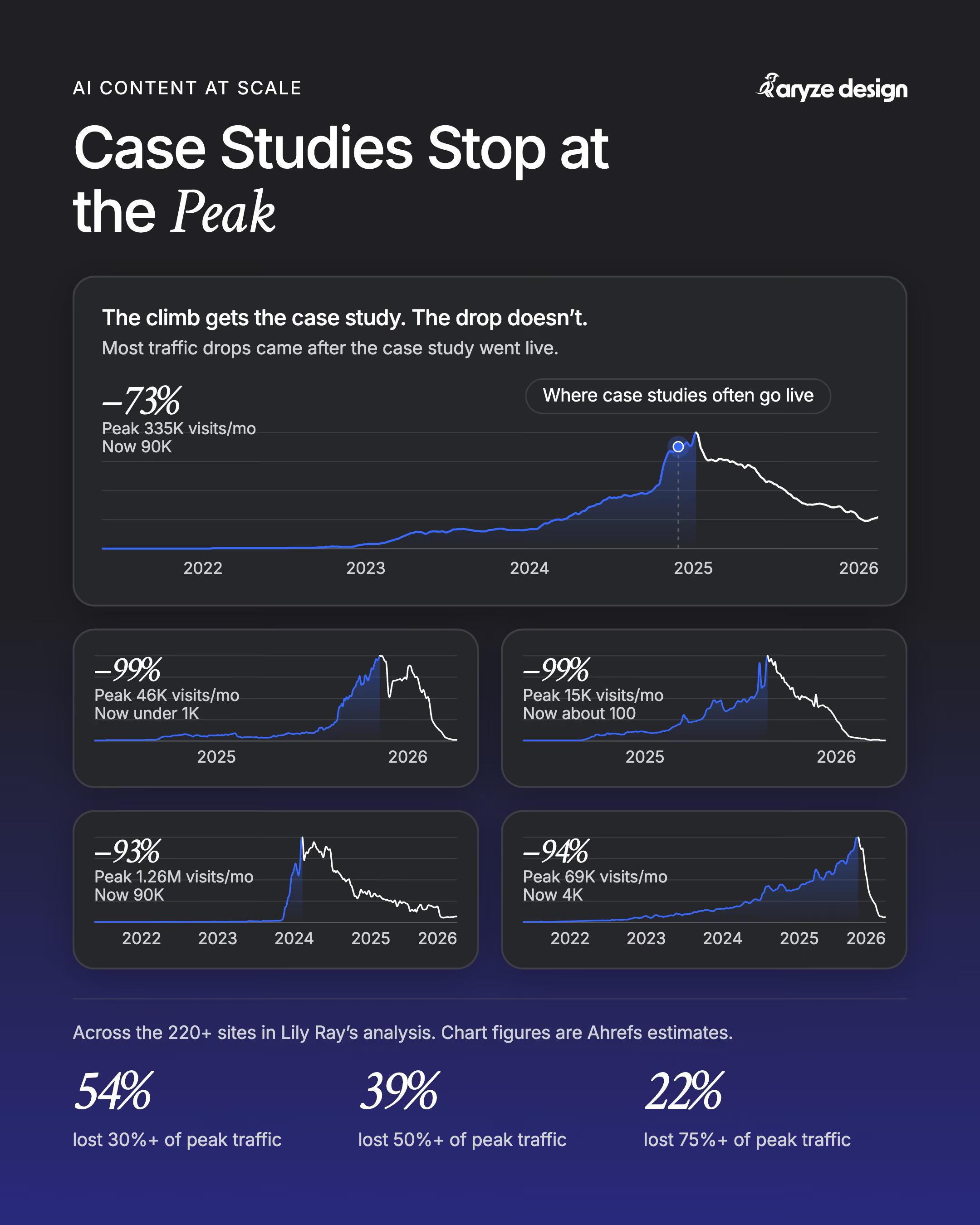
In May 2026, Lily Ray, one of the most closely followed SEOs in the industry, published an analysis of more than 220 websites listed as success stories on the customer pages of over a dozen AI content platforms. Of those sites, 54% lost 30% or more of their peak organic traffic, 39% lost half or more, and 22% lost 75% or more. Many of those drops came after the case studies were published, and a good number of the brands have since removed or redirected the very pages that were celebrated as wins.
Then came Google’s August 2026 spam update. SEO consultant Glenn Gabe documented a site in an ultra-YMYL niche (the same high-stakes category financial content falls into) that leaned on programmatic and AI-generated content. It completely lost its rankings for over 200,000 queries.
Ryan Law, who runs content marketing at Ahrefs, studied 331,000 pages this July and pointed to what SEOs now call “Mount AI” traffic graphs, where sites scale content with AI, spike in rankings, then watch organic performance tank a few months later. In his data, pages with low to moderate AI content earned two to three times the impressions of heavily AI-generated pages. His conclusion is that Google punishes bad content, and AI content and bad content overlap a lot of the time.
That’s the pattern I want you to watch for. You might see a surge to start and a steep decline to finish. That finish could be a handful of weeks out, a few months out, or even a few days. During the surge, traffic and conversions can tick up enough to build a pretty convincing case study about how effective the service is. The case study just stops before the plummet.
What Google’s AI Optimization Guide Says
Google, just a handful of months ago, published their official guide on optimizing your website for generative AI features on Google Search. It’s nearly as close as a developer can get to a rulebook for AEO (if you want the deeper breakdown of how SEO, AEO, and GEO fit together, I covered it in Generative Search Is Still SEO).
The short version (albeit not how Google would say it) is that optimizing for AI search is still SEO, and some quick AI-generated content hack won’t help you. Now, we’ll get into the more technical layer below, but the guide says quite the opposite of handing your content over to AI to post at will.
“Create the content yourself”
In the section on providing a unique point of view, Google writes:
“Create the content yourself based on what you know about the topic, and consider what in-depth experience you can bring to your content. Don’t just recycle what others on the internet have already said, or could easily be produced by a generative AI model.”
Could it be more specific? Read that last bit again. “...or could easily be produced by a generative AI model.”
Sure, skills could get you a little more dialed in, filter out a few AI words or phrases (although they often do a bad job at this, too), and sound a bit more like you. But it’s unlikely to get anywhere close to genuine and authentic. Trust me, we’ve tried (more on this later).
That’s Google, in its own guide to AI search, telling you to write your content yourself. It’s hard to get more direct than that.
Commodity vs. non-commodity content
Google splits content into two camps. Commodity content is something like “7 Tips for First-Time Homebuyers,” built on common knowledge that could literally be written by anyone. Non-commodity content is something like “Why We Waived the Inspection & Saved Money: A Look Inside the Sewer Line,” which Google says “provides unique expert or experienced takes that go beyond common knowledge and the ordinary.”
Swap in advisor topics and it gets clearer. “5 Tips for Saving for Retirement” is commodity content, and an AI tool will produce a near-identical, sometimes word-for-word version for both you and your competitor. “Why I Told a Client to Work One More Year” is non-commodity content. Now, I know, that title is a little lame and could be a lot more targeted to reflect your niche, but the point is it comes from your own experience.
Top SEO agencies build around this, too. HeyTony, the agency founded by Get Found author Matt Diamante, builds its content by interviewing clients and pulling out their insights, because, as its site puts it, “AI can’t fake experience.”
So, in all of this, how are you possibly going to get content that reflects your personal experiences with clients and prospects alike if you’re not the one writing it? If an AI platform gets even remotely close to producing something that reads like personal experience, ask yourself two things. Are other advisors posting the exact same content? Are you selling a lie to your clients and prospects by posting a story you didn’t live?
Platforms usually answer this with an approval step, where you read the post before it goes live. Approving a post someone else’s AI wrote is more or less the same as having AI generate content for you and approving it yourself. Your experience still isn’t in it.
How AI search finds your content
Google’s guide explains that its AI features are rooted in the same core ranking systems as regular search. They use retrieval-augmented generation (RAG), pulling relevant pages from Google’s search index to ground their answers, along with query fan-out, where the model runs a batch of related searches behind the scenes to fill in the picture.
For you, that means looking more broadly at keywords and covering more of the topics around what you do, with a large pool of genuinely useful posts that link to each other. When someone asks an AI tool a question in your niche, there’s plenty of your content for it to find and pull from.
Volume works against you
Google draws a firm line here, though. It warns against creating separate content for every possible variation of how people might search (fan-out queries included), and says doing it to manipulate rankings or AI responses violates its scaled content abuse policy. In Google’s words, “a high quantity of pages doesn’t make a website higher quality or more relevant to users.” Autopilot publishing is a volume play by design.
Review everything, especially in finance
Google’s separate guidance on generative AI content says using AI to generate many pages without adding value for users may violate that same spam policy, and that it’s critical to manually fact-check and review all AI-generated content before publishing.
As an advisor, you may not even know it, but that carries extra weight for you. See, financial topics fall under what Google calls “Your Money or Your Life” content, where accuracy and credibility get held to a higher standard, and Google’s helpful content documentation names trust as the most important piece of E-E-A-T. Add compliance on top of that, and gosh, the whole “set it and forget it” approach is an SEO/AEO liability.
“Be wary of third-party tools that promise ranking success”
This next one is literally word-for-word from Google’s guide:
“Be wary of third-party tools that promise ranking success or claim to use ‘internal’ Google metrics. No third-party tool has access to our internal ranking or AI systems.”
Google goes further in its guidance on third-party SEO tools and advice, which, if you’re still evaluating a tool that promises all this AI success, is worth a read.
What the Data Says
Advisors need proof before making a decision (I respect that, you do it for a living), so let’s look at the numbers from the two biggest names in SEO research.
To give AI some credit, Ahrefs put out an article in July 2026 titled “Google Doesn’t Punish AI Content; It Punishes Bad Content.” Before you go and jump the gun and say, “Whoa, Taylen, doesn’t that negate everything you’ve said up to this point?” the answer is no, and here’s why. Ahrefs looked at pages ranking in positions one through three and found:
- 54.7% of top-ranking pages returned an AI content level under 20%.
- 27.5% returned an AI content level of 20–50%.
- 8.8% returned an AI content level of 50–80%.
- 9.0% returned an AI content level of 80% or more, including 5.3% that came back 100% AI.
Now, for some perspective, the largest chunk of the pie (54.7%) is content that’s less than 20% AI. That means more than half of the pages winning the top three spots are at least 80% human-written. Add the next group and 82.2% of top-three rankings go to pages that are less than half AI. Ahrefs also found pages with low to moderate AI content earned two to three times the impressions of heavily AI-generated pages, and Ryan Law’s conclusion is that Google punishes bad content, which overlaps with AI content a lot of the time.
You can still let AI do some of the lifting on your blogs. The vast majority of the content ranking at the top (as of today, before AI detection inevitably gets better), though, is mostly human-written. We encourage advisors to start by word dumping their thoughts for a blog onto a page and having AI write it. Then we go in and rewrite the bulk of the article so it can rank.
You’re a financial advisor, which means you understand risk and numbers (I would hope, anyways). Would you rather your content fall in the group that takes 82% of the top three spots, or the group that takes 18%? AI can still be part of it, as long as you’re editing the content. Keep in mind, too, that these are the pages already earning top-three spots, many from established publications with editors who know how to spot AI tells. You more than likely don’t. So, are you confident your AI-written content is going to land with them? The numbers get worse as the content does, and it would be a safe bet to assume your advisor-edited, AI-generated content isn’t going to get you there.
Semrush backs this up from another angle. In a study published in April 2026, it pulled the top 10 Google results for 20,000 keywords, filtered them down to about 42,000 blog posts, and ran every one through GPTZero, an AI detector. Pages that read as fully human-written beat AI and mixed content at every position on page one. The gap was widest at the top, where results in position one were eight times more likely to be human-written than AI-generated.
Think about what that means for your practice. Position one versus position seven is the difference between a prospect landing on your site and never seeing it. Notice, too, that Semrush sorted those pages with an AI detector, and the content winning the top spot was the content that passed.
Passing AI Detection Is Hard, Even When You Write It Yourself
For a couple of years now, our team has been running content through AI detectors, seeing what comes back, and studying how the flagged sentences are written. We use somewhere between 10 and 15 detectors when we’re checking a piece. AI-written content might pass three or four of them, the ones checking for certain things, and fail the other six that are checking for something else entirely. We’ve even had sentences we wrote ourselves, by hand, come back flagged as AI. Over time you learn the difference between how AI writes and how people write, but it takes a lot of reps to get there.
The target keeps moving, too. We find new AI keywords and phrases every other week. The ones we’re catching right now will probably look different if you’re reading this three months from now, and they looked different three months ago. As AI tries to sound more human, detection gets thicker and more layered right along with it. AI may get better at writing (although I’m not sure it will), but Google will almost certainly get better at spotting it. The more people can put out content that anyone could put out, the harder search engines have to work to keep it from showing up.
The DIY Blueprint (Please Don’t Use It)
If you’re evaluating a service that publishes AI content for you, you’d be better off building it yourself. It’s easier than you’d think:
- Open Claude and set up a scheduled task. Give it context on how to write a good blog (our post on SEO for advisor blogs is a decent starting point) and have it build a skill from that.
- Give it a list of the AI keywords and phrases that show up constantly, and tell it to avoid them.
- Pick your schedule, whether that’s weekly, biweekly, or monthly.
- Connect your website. Plenty of website platforms have an MCP connection now. Webflow, the one we work with, can connect straight to Claude and publish on your behalf without you ever touching the site.
The same can be done with ChatGPT. You’ve now built the exact service you were about to pay thousands for, using a tool you probably already own.
I’ve given you the blueprint, and it’s garbage, so please do not do this. You will still fail AI detection. Whatever you publish, you need to read it yourself and make sure it:
- Sounds like you
- Is non-commodity content
- Doesn’t carry the patterns AI always leaves behind
We Tried to Build It Ourselves
We pay close attention to AI, partly because we have zero interest in being overtaken by someone who uses it better than we do. As a small team, we have the room to dig into this stuff and be more forward-thinking than larger firms in the advisory industry, so we spent time seriously exploring a platform that would do everything I’ve described in this post.
We dug into how the skills are written and how to get past AI detection. Despite every attempt, we kept getting stuck behind detection, with keywords bleeding through our skills even when those skills were written specifically to keep them out. What we found is that it’s impossible to get the rankings and visibility you’re after this way without someone reviewing and rewriting the content. If this worked, we’d be doing it.
We’re not alone in landing there, either. On a November 2025 episode of The Edward Show, Edward Sturm (an SEO who’s worked with Microsoft and TIME) broke down why one founder shut down his own AI SEO startup after realizing that so-called generative engine optimization is just good SEO repackaged.
Unless a company has a copywriter for every five or so advisors it takes on each month, the content going out is going to be content that gets detected. You’ll see the surge at first, then it plateaus and dies out.
For context, we live and breathe this space. As the founder, I’m putting in 10 hours a day, every day, across client work, prospecting, and building the business. Lately a lot of that time has gone into business building, including a new product we’re planning to launch in the next handful of months that meets advisors’ needs in a different area (I’m excited to share more soon). We’ve looked hard at using AI to get better results for our clients, and the tool that does this effectively doesn’t exist. That’s the same reason the largest publications in the world still have people writing for them. It’s a dream, and it sounds amazing, but it isn’t there.
AI Still Has a Time and Place
AI has its purpose in all of this, and we use it. Google itself says generative AI can be useful for researching a topic and adding structure to original content, and I agree. What it tends to do is shift your time around. It cuts down the hours you spend writing a blog and adds to the hours you spend reviewing it, so it all sort of balances out. The review is where your experience and your voice get in, and that part can’t be automated.
What Gets Results (and How Long It Takes)
We all want the quick win, a tool that drives traffic and generates leads without us doing a thing. The things that move the needle, though, are the best practices Google has promoted for years:
- Keyword research built around what your prospects search for
- Internal linking between related posts
- External linking to credible sources
- A published date on every post
- A named author
- An author who’s credible on the topic (for advisors, that’s you)
- A table of contents that reflects every point the post covers
Even with all of that in place, we typically see the incline land somewhere around 6 to 12 months, and only when advisors stay consistent and post content that reflects what people are searching for.
Where Aryze Fits In
We designed our membership around man-hours, because that’s what this work takes. Each month we retain a block of hours you can put toward whatever design, marketing, or website needs come up. Sometimes that means taking AI-written drafts and rewriting them by hand so they sound like you and carry the non-commodity takes Google is looking for. Other times it means designing graphics for social media, creating landing pages with automated email sequences, tailoring a marketing strategy, or doing keyword research and implementation. The list goes on.
The dream from the beginning of this article? It’s still possible. It just requires hiring humans, rather than spending massive amounts on AI content you could otherwise generate yourself.
Compared to some of the price points we’re seeing from AI content tools and platforms across the industry, you’ll often get more content from us, and every piece is built on the keyword research, linking, authorship, and structure above. If you want a straight, jargon-free conversation about what that could look like for your firm, book a free assessment.
Where Advisor Brands Get Stronger
Conversion-focused advisor website updates, niche messaging, and search visibility (so you see measurable marketing progress).
How AI Search Is Forcing a Rethink of the Advisor Marketing Funnel
Prospects now ask AI who to hire before they ever hit your site. See why niching down & cleaning up old pages matters more than ever for advisor marketing.
Conversion Optimized Marketing Funnels for Financial Advisors
Choose your channels, work all four funnel stages & find the leak that's costing you booked calls. A stage-by-stage walkthrough written for financial advisors.

Launching or Rebranding a Financial Advisory Firm: The Order to Do It In
Your niche shapes the name, the name shapes the logo, & the logo shapes the website. Walk the order to launch or rebrand a firm without paying for it twice.

The StoryBrand Framework For A Financial Advisor Website
See how the StoryBrand framework turns your advisor homepage into a page James reads, block by block, from the hero section down to testimonials that seal it.

The ARYZE Marketing Tech Stack: What We Recommend, and Why It's Right for Advisors
The exact websites, email, AI & automation tools we hand advisors—real pricing, real trade-offs, & no bloated software graveyard of logins you'll forget.

Generative Search is Still SEO. AEO + GEO Are Tactics to Sell You.
Confused by AEO and GEO pitches? Google says optimizing for generative AI search is still SEO. Here's what's real, what's recycled, and what to focus on.

Measuring What Matters: Simple Marketing KPIs for Financial Advisors
Learn the key KPIs advisors should track—leads, meetings, CAC, CLV & website metrics—to measure marketing performance & build a predictable growth engine.

Your Step-by-Step Guide to Marketing Funnels for Financial Advisors
Learn how financial advisors can use a simple 4-step marketing funnel to attract prospects, build trust, convert leads, and create lifelong clients.

Your Advisory Website Is a Pre-First-Meeting Experience
Learn how a strong advisor website builds trust, lowers acquisition costs & turns curious visitors into booked meetings by showing relevance & credibility.

What Makes a Great Logo for Financial Advisors?
Learn how to choose a logo that resonates with your audience, reflects your brand’s values & hot to find the right designer to bring your vision to life.