
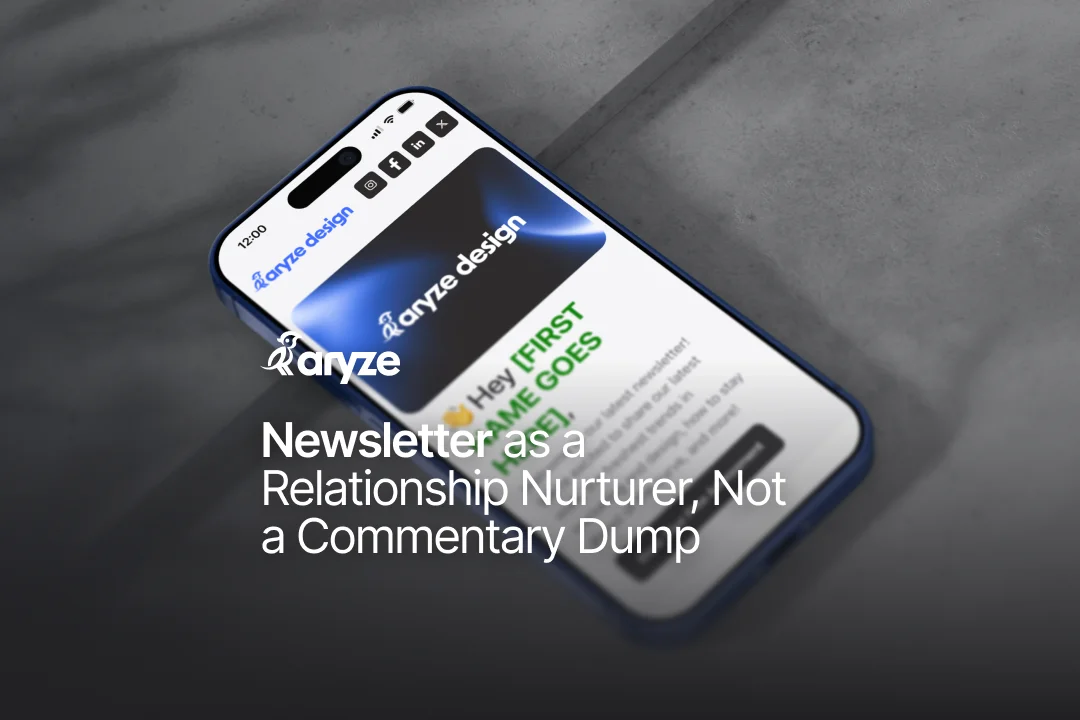

Newsletter as a Relationship Nurturer, Not a Commentary Dump

If you’re still using your financial advisor newsletter purely to recap what the markets did this week, you’re totally missing the point.
As someone who thinks about marketing strategy for advisors, I’ve seen time and again how a newsletter can do so much more: build loyalty, drive action, and convert prospects. A financial services newsletter should be a relationship-nurturing tool, not just another stream of charts and commentary.
Think of it this way: your newsletter isn’t the place to prove how well you know the market—they generally already know (or expect) you already know that. It’s the place to prove how well you know your clients. When done right, this kind of newsletter becomes part of the reason clients stay with you, refer others, and trust your advice.
Why Email Still Works for Advisors
Email remains one of the highest-return digital marketing channels even in 2025. Across industries, reports show returns of about $36 to $44 for every $1 spent on email marketing.
For the advisory world in particular, this matters. A structured marketing approach (which includes a consistent newsletter) correlates with stronger lead generation and client acquisition. One survey found advisors using defined marketing strategies generate 168% more leads and onboard 50% more new clients annually compared with peers without a strategy.
Here’s why that’s so relevant: when you send a newsletter that offers value and builds habits, you stay front of mind. When clients think of you first—not just when markets wobble—you have the edge.
What Clients Actually Want (and What They Don’t)
Let’s be real: clients don’t want another email full of market commentary.
They want communication that resonates with their world.
A clean, well-written financial services newsletter meets them where they are:
- Nearing retirement and wondering what to check off their list.
- Saving for a child’s education and thinking “what’s ahead?”
- A business owner facing succession planning.
- Someone who just wants confirmation they’re still on track.
Research by a UX (user experience) firm that monitors newsletters found that readers stay loyal when emails are useful, scannable, and actionable.
Contrast that with an email that says: “Markets were up 1.2% this week; here’s what we think about inflation.” It may be accurate—but clients generally don’t care in that way.
Don’t get us wrong either, some clients do care. I’ve worked with advisors where we’ve actually leaned into this sort of positioning.
In general though, what they do care about is something more along the lines of: “Here are three small steps you should check off this month.” That kind of utility builds trust.
How to Make Your Newsletter Engaging and Client-Focused
1. Tone and Format
Write like you’re talking to a friend—not like a researcher. Use plain English. Reference best-practice research: The most successful email subject lines among advisors are short and state a clear value proposition. One study of 2,700+ subject lines found open rates as high as 68% when value was clear and the character count low.
Structure matters too—mobile-first single column layout, clear headings, generous white space, one bold CTA. According to UX research, scanned readability correlates with action.
2. Segmentation + Personalization
Segmenting your audience raises engagement. If you send the same newsletter to every client, you’ll get lukewarm results. If you tailor for “near-retiree,” “business owner,” “young family,” etc., or even to those in different steps of the funnel, you'll see far better open, click, and conversion rates. One report says personalization can increase click-through by 14% and conversions 10% or more.
3. Consistent Cadence and Brand Voice
Pick a rhythm—monthly or bi-weekly—and stick to it. Clients will come to expect and (if you’re doing it right) enjoy your newsletter. A predictable format breeds trust. If your voice is consistent, you become a brand they recognize and value.
4. Growth Mechanics and Referrals
Your newsletter should also serve growth. Embed a “Forward to a friend” link or a unique referral code. Encourage readers to share. One publication outside of advisory (but instructive) grew via a referral engine that generated 30-80% of list growth. Emulate that in a compliant, advisor-friendly way.
What Top Newsletters and Best Investment Magazines Teach Us
If you want to improve your own newsletter, study the top rated financial newsletters and the best investment magazines. They set benchmarks in tone, cadence, and brand.
- Nerd’s Eye View by Michael Kitces (advisor-audience) shows how structure and consistency win. They’re often a touch long.
- HumbleDollar (by Jonathan Clements) speaks to investors in plain language, a strong model for client-facing writing.
- A Wealth of Common Sense (by Ben Carlson) keeps things simple, actionable, no jargon.
- TLDR by Wealthsimple (Canada) scales with a strong editorial voice—shows advisers can emulate an “educational brand” mentality.
- Even non-advisor-specific newsletters like Morning Brew teach growth mechanics: shareability, skimmable design, every-edition expectation.
From these you’ll learn: regularity matters more than frequency, clarity beats complexity, and a loyal habit of reading equals trust.
Metrics That Matter
When I work with advisors on their email marketing, I emphasise metrics tied to business results and their marketing situation—not just opens. That said, here are useful benchmarks:
- Delivery rate: aim for ≥ 98% (good list hygiene = trending).
- Unsubscribe rate: target ≤ 0.4% per send.
- Click-through rate (CTR): 2–4% toward your primary CTA is a good ballpark.
- Conversion/meeting-booked rate: this is key—track “send → CTA click → meeting booked” and “send → task completed (e.g., beneficiary review)” rather than just “click”.
- List growth: net growth of ~1–2%/month keeps your future funnel active—especially when referrals are baked in.
And the big number: email ROI. The fact that you can still see ~40:1 (or higher) opportunities means abandoning the channel isn’t an option. Especially when marketing budgets tighten, email is consistently cost-effective.
Practical Campaign Ideas for Advisors
Here are a few campaign ideas you can implement starting next month:
“Life Calendar” Monthly Newsletter (12×/year)
Each edition has two simple items: one planning checklist (“What you should check this month”), one behavioral piece (“Why many near-retirees still feel uneasy”). Then a CTA: “Book your 20-minute planning check-in.” Segment the list by life stage for relevance. Track which checklist items were clicked.
“Moments That Matter” Micro-Series (6×/year)
Segment your list: new parents, business owners, pre-retirees. Send a 4-minute read + downloadable checklist. Include “share with someone who knows someone.” Add a compliant testimonial snippet. Track segment-specific opens, referrals, and meeting bookings.
Quarterly “Snapshot / One-Page Plan” Email
Send to existing clients. Include a summary of goals, progress, two next-actions. CTA: “Confirm you’re ready or book a review.” Measure responses, fewer inbound “what should we do about the market?” calls.
Referral Engine Newsletter Edition
Every x months include a “Share this with someone” CTA at the bottom. Offer a small value-add for the reader who refers (e.g., a charity gift in their name or a free checklist). Track referral link clicks and conversions.
Putting It All Together
When you meet the client where they are, speak in plain language, give them something to do, and stay consistent, you elevate the conversation from “what happened” to “what happens next—and how we’re helping”.
As you build or refresh your newsletter: make it about your client’s life, not the market’s mood. Use segmentation, design for mobile, schedule with discipline, track with purpose, and comply with confidence. Then watch the newsletter become not just a piece of marketing, but a piece of your value proposition.
Many of our clients at Aryze Design have seen substantial growth because of their newsletters. If you would like to chat about your own newsletter, or just marketing in general, let’s get in touch!
Where Advisor Brands Get Stronger
Conversion-focused advisor website updates, niche messaging, and search visibility (so you see measurable marketing progress).
Dying Sites: The AEO Plummet From AI-Generated Content
AI content platforms promise advisors traffic on autopilot. See what Google's own guidance & data from Ahrefs & Semrush show what happens after the early surge.
How AI Search Is Forcing a Rethink of the Advisor Marketing Funnel
Prospects now ask AI who to hire before they ever hit your site. See why niching down & cleaning up old pages matters more than ever for advisor marketing.
Conversion Optimized Marketing Funnels for Financial Advisors
Choose your channels, work all four funnel stages & find the leak that's costing you booked calls. A stage-by-stage walkthrough written for financial advisors.

Launching or Rebranding a Financial Advisory Firm: The Order to Do It In
Your niche shapes the name, the name shapes the logo, & the logo shapes the website. Walk the order to launch or rebrand a firm without paying for it twice.

The StoryBrand Framework For A Financial Advisor Website
See how the StoryBrand framework turns your advisor homepage into a page James reads, block by block, from the hero section down to testimonials that seal it.
The ARYZE Marketing Tech Stack: What We Recommend, and Why It's Right for Advisors
The exact websites, email, AI & automation tools we hand advisors—real pricing, real trade-offs, & no bloated software graveyard of logins you'll forget.

Generative Search is Still SEO. AEO + GEO Are Tactics to Sell You.
Confused by AEO and GEO pitches? Google says optimizing for generative AI search is still SEO. Here's what's real, what's recycled, and what to focus on.

Measuring What Matters: Simple Marketing KPIs for Financial Advisors
Learn the key KPIs advisors should track—leads, meetings, CAC, CLV & website metrics—to measure marketing performance & build a predictable growth engine.

Your Step-by-Step Guide to Marketing Funnels for Financial Advisors
Learn how financial advisors can use a simple 4-step marketing funnel to attract prospects, build trust, convert leads, and create lifelong clients.

Your Advisory Website Is a Pre-First-Meeting Experience
Learn how a strong advisor website builds trust, lowers acquisition costs & turns curious visitors into booked meetings by showing relevance & credibility.