
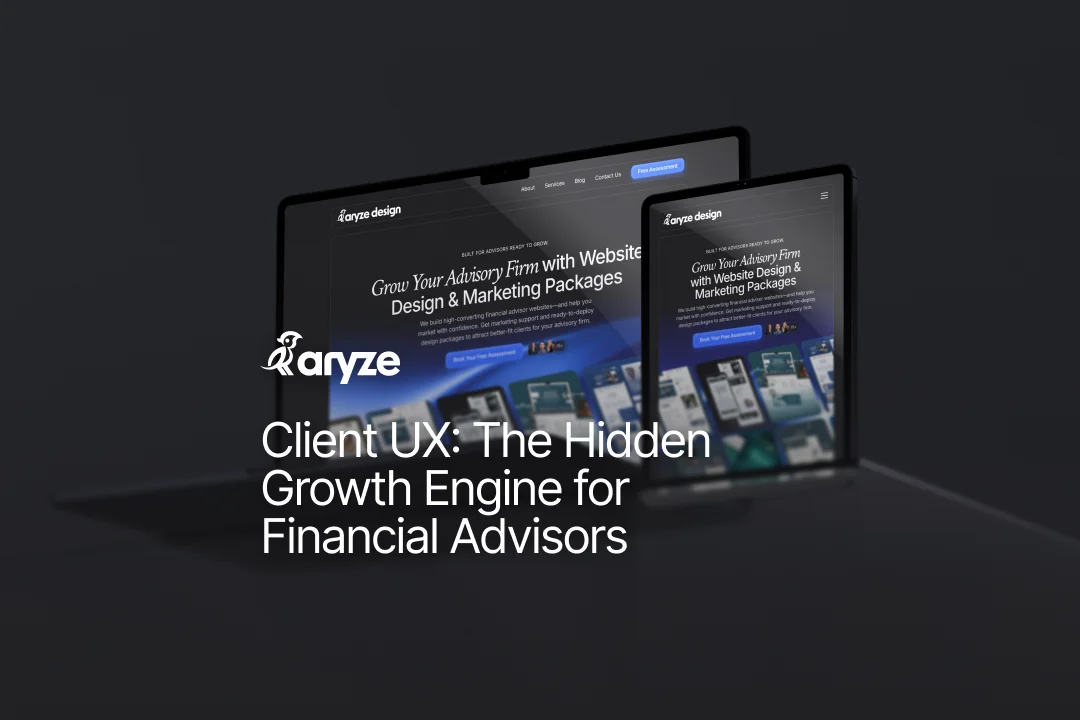

Client UX: The Hidden Growth Engine for Financial Advisors

As a marketing agency that lives in the world of advisor marketing and financial advisor branding every single day, we consistently spot the same patterns.
Advisors who obsess over Client UX—the actual experience of being your client—grow faster, retain more households, and generate more referrals than those who simply ‘have a website and hope.’
This isn’t just about having a pretty website. It’s about designing every touchpoint in a way that feels easy to navigate, clear to understand, and trustworthy as a product.
What “Client UX” Really Means for Your Practice
In the UX world, user experience is the way someone feels as they interact with your service—how easy it is, how confident it makes them, and whether it keeps them coming back.
For a financial advisor, client UX may extend to the experience of being your client from first Google search to ongoing quarterly reviews. It would generally include things like:
- How they find you.
- What happens on your website.
- How it feels to book a call, sign paperwork, and log into your client portals.
- How you communicate during markets, tax season, and major life events.
If you’ve ever sketched out how someone goes from “I don’t know you” to “you advise my entire family,” you’ve already dabbled in journey mapping. Tools like HubSpot’s customer journey mapping guides and customer journey analytics show how companies visualize each step, identify friction, and redesign the experience around the client.
At its core, client UX is about understanding those you work with deeply enough that everything you’ve done, from prospecting, onboarding, and ongoing feels intentionally thought out for them—your messaging, process, and digital experience all line up.
Why Client UX Drives Revenue, Not Just Warm Fuzzies
While client UX may sound soft, the business impact is hard numbers.
UX research summarized by firms like Eficode and Baymard Institute suggests that every $1 invested in UX can return about $100 in value. Well-designed interfaces can increase conversion rates by up to 200%, and strong UX overall can boost conversions by up to 400%.
Design-led companies have also been shown to outperform the S&P 500 by more than 200% over a decade, according to the same UX statistics.
Customer experience research backs this up. Zendesk’s reports on customer service and experience show that around 75% of consumers are willing to spend more with businesses that provide a good experience, and many make purchase decisions based primarily on the service they expect, not just price.
In wealth management specifically, Russell Investments’ “Value of an Advisor” research estimates advisors add several percentage points of value per year through behavior coaching, tax planning, and a more personalized planning experience. That “personalized experience” piece is essentially client UX in disguise.
Digital experience is now central. The J.D. Power U.S. Wealth Management Digital Experience Study describes websites and apps as “the window to the wealth management client experience” and finds that more frequent digital engagement correlates with higher satisfaction and loyalty.
And on the advisor marketing front, Broadridge’s 2024 Financial Advisor Marketing Trends Report shows that advisors with a defined marketing plan—including a clear digital strategy—generate about 168% more leads via their websites and onboard roughly 50% more clients per year than those without one.
When you connect the dots, client UX isn’t a mere side project; it’s genuinely a growth engine.
How Marketing Leaders Understand Clients (and How You Can Copy Them)
Marketing leaders don’t guess what clients want. They research, test, and iterate.
Companies like HubSpot and Salesforce talk a lot about the buyer’s journey—awareness, consideration, decision—and the broader customer journey after the sale. Their content on customer journey analytics and sales behavior highlights a few realities that matter for advisors:
- Buyers prefer to research independently before talking to a human.
- A large chunk of the “sale” happens via your content and website before a call is ever booked.
In other words, your financial advisor website is the salesperson before your intro call.
As a marketing agency, this is exactly how we approach financial advisor marketing. We treat your prospects like users and your firm like a product: understand their behavior, design around their needs, and test what actually works.
Research That Actually Helps Advisors (Without Becoming a Data Scientist)
You don’t need a data science team to improve client UX. You just need a simple system to keep learning from your clients and prospects.
Quantitative research is about what’s happening:
- Use website analytics (Google Analytics, Google Search Console, HubSpot, etc.) to see which pages attract visitors, which pages lead to booked calls, and what your overall conversion rate looks like from visitor to lead to client.
- Track basics in your CRM: where leads come from, how long they take to convert, and close rates by source (referrals vs SEO vs webinars).
- Send quick client surveys or NPS-style questions after onboarding and annual reviews to measure satisfaction and ask what could be easier.
Qualitative research gets at why it’s happening:
- Have short, structured conversations with a handful of clients each quarter. Ask what nearly stopped them from working with you, what made them feel confident, and how they’d describe your value to a friend.
- Do simple usability tests: watch a client or friend use your website to decide whether they’d book a meeting, and pay attention to where they get stuck.
- Read online reviews of competitors and even digital-only platforms. You’ll see repeating themes around communication, clarity, responsiveness, and digital tools—all core to client UX.
As marketers, we often combine these: analytics to spot problems (low conversion, high bounce rate) and conversations to understand the emotions and language behind them. You can absolutely do a lighter version of this inside your own practice.
Why Your Website Beats Any Brochure or Business Card
If we could wave a magic wand for most firms, we’d upgrade their financial advisor website before anything else.
Research compilations from agencies such as DigitalConsultants and HigherVisibility add another important point: roughly 38% of people stop engaging with a site if the layout or content is unattractive or confusing.
A strong financial advisor website acts as a 24/7 “first meeting.” It explains who you serve, how you help, and what to do next. It carries your financial advisor branding consistently across pages, supports niche-specific content (e.g., business owners, physicians, tech employees), and makes it effortless to book a call.
With a modern CRM like HubSpot or a similar platform, you can capture leads, nurture them with email, and see exactly which content and campaigns are driving new clients. HubSpot’s own marketing statistics highlight how content, landing pages, and automated workflows increase lead volume and conversion—the same mechanics you can use in financial advisor marketing.
When we redesign a site with client UX in mind, we’re not just making it prettier. We’re deliberately removing friction, clarifying the journey, and giving your best prospects a clear, confident path from “I’m curious” to “Let’s talk.”
Can You DIY Client UX or Should You Get Help?
We believe advisors can and should own the understanding of a client piece. You are closest to your clients’ fears, goals, and language.
You can absolutely:
- Sketch your client journey and identify where people get confused or overwhelmed.
- Run a few client interviews and simple surveys each year.
- Monitor basic website and funnel metrics and notice what’s improving or slipping.
Where a marketing partner like us helps is turning that insight into a fully realized, high-performing experience:
- Translating your client knowledge into clear positioning and messaging that supports your financial advisor branding.
- Designing and building a UX-focused financial advisor website that looks great, loads fast, and is built to convert.
- Setting up analytics, CRM integrations, and campaigns so you can see which advisor marketing efforts are paying off and double down on them.
Given the UX ROI estimates (that famous $1 into UX = $100 out and 200–400% conversion lifts with better UX), investing in professional help usually makes sense once your client lifetime value is measured in the tens or hundreds of thousands.
Bringing It All Together
Client UX isn’t just about looking modern or having a slick portal. It’s the end-to-end experience of being your client—and it’s one of the most leveraged growth levers in your business.
When you intentionally design that experience, backed by research and data, three things happen:
- More of the right people find and resonate with your website.
- More prospects convert into ideal clients, with less friction and fewer “ghosted” first meetings.
- Existing clients feel supported and understood, leading to higher retention and more referrals.
That’s really the core of great financial advisor marketing today: truly know your clients, design everything with them in mind, and let a strong client experience do a lot of the heavy lifting.
Getting to that level of understanding takes time—and that’s what we’re here for. Reach out anytime, and we’ll help you build a platform that genuinely serves your clients better.
Great advisors deserve great marketing.
Where Advisor Brands Get Stronger
Conversion-focused advisor website updates, niche messaging, and search visibility (so you see measurable marketing progress).
How AI Search Is Forcing a Rethink of the Advisor Marketing Funnel
Prospects now ask AI who to hire before they ever hit your site. See why niching down & cleaning up old pages matters more than ever for advisor marketing.
Conversion Optimized Marketing Funnels for Financial Advisors
Choose your channels, work all four funnel stages & find the leak that's costing you booked calls. A stage-by-stage walkthrough written for financial advisors.

Launching or Rebranding a Financial Advisory Firm: The Order to Do It In
Your niche shapes the name, the name shapes the logo, & the logo shapes the website. Walk the order to launch or rebrand a firm without paying for it twice.

The StoryBrand Framework For A Financial Advisor Website
See how the StoryBrand framework turns your advisor homepage into a page James reads, block by block, from the hero section down to testimonials that seal it.

The ARYZE Marketing Tech Stack: What We Recommend, and Why It's Right for Advisors
The exact websites, email, AI & automation tools we hand advisors—real pricing, real trade-offs, & no bloated software graveyard of logins you'll forget.

Generative Search is Still SEO. AEO + GEO Are Tactics to Sell You.
Confused by AEO and GEO pitches? Google says optimizing for generative AI search is still SEO. Here's what's real, what's recycled, and what to focus on.

Measuring What Matters: Simple Marketing KPIs for Financial Advisors
Learn the key KPIs advisors should track—leads, meetings, CAC, CLV & website metrics—to measure marketing performance & build a predictable growth engine.

Your Step-by-Step Guide to Marketing Funnels for Financial Advisors
Learn how financial advisors can use a simple 4-step marketing funnel to attract prospects, build trust, convert leads, and create lifelong clients.

Your Advisory Website Is a Pre-First-Meeting Experience
Learn how a strong advisor website builds trust, lowers acquisition costs & turns curious visitors into booked meetings by showing relevance & credibility.

What Makes a Great Logo for Financial Advisors?
Learn how to choose a logo that resonates with your audience, reflects your brand’s values & hot to find the right designer to bring your vision to life.